
Follow a student's CGM, in Glide
- The parent connects the CGM in Glide: pick it here.
- The parent goes to Settings → Followers → Invite a follower and sends the code, or taps Send invite link.
- The nurse installs Glide, taps Watch someone else's glucose, enters the code and taps Join.
- On the nurse's phone, Settings → Notifications: turn on Low and set At or below (80 mg/dL by default), and turn on Signal lost.
- For the care plan meeting: Insights → Share report as PDF, for 3 to 180 days (30 by default).
What you see
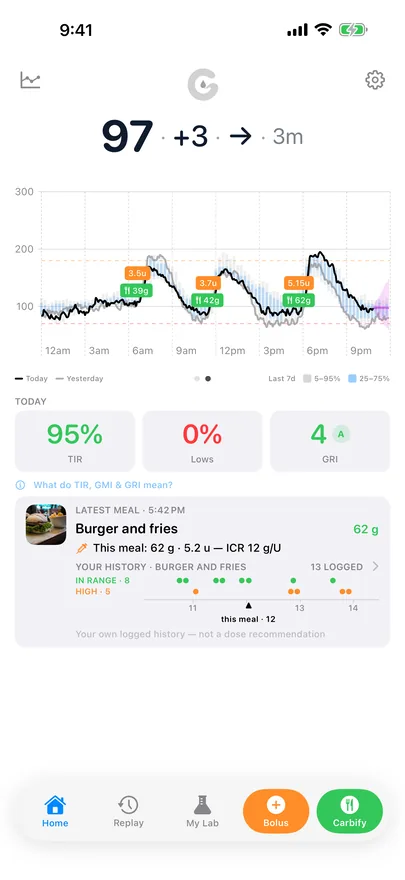
- The same reading, arrow and chart the parent sees.
- Alerts only for what the nurse turned on. The parent's alerts stay as the parent set them.
- Meals and doses anyone on the profile logged, with the time.
Questions
Can the nurse log carbs and insulin?
Yes. Anyone on the profile can log meals and doses, and everyone on it sees them.
How does the nurse stop following at the end of the year?
The parent opens Settings → Followers and removes the nurse. The nurse loses access at once and needs a new code to follow again.
Does the nurse get a call at night?
Only if the nurse sets one up. The nighttime call goes to the phone numbers people add for themselves.
What does Glide cost?
Glide is free: readings, the chart, followers, alerts, the nighttime call, the report and the Apple Watch app. Glide Premium ($4.99 a month or $39.99 a year, two weeks free) adds photo carb counting and My Lab's food groups.
More with Glide
Connect the student's CGM
For the care plan
Federal law, in every state
Section 504 of the Rehabilitation Act (29 U.S.C. § 794) bars disability discrimination in any program that receives federal money, which includes public schools. Its regulation (34 CFR § 104.33) requires public schools to provide a free appropriate public education to each qualified student with a disability. (U.S. Code (Cornell LII); eCFR)
The ADA definition of disability, which Section 504 uses, counts the endocrine system as a major bodily function (42 U.S.C. § 12102(2)(B)). The US Department of Education Office for Civil Rights says a student with diabetes has a disability if the diabetes substantially limits a major life activity, and that a school may accept this without documentation. (U.S. Code (Cornell LII); US Dept. of Education)
The Office for Civil Rights diabetes fact sheet (February 2024) lists modifications Section 504 may require: snacks during instruction, letting a capable student carry glucagon and insulin, staff trained to give glucagon and check blood sugar, and exam and attendance changes. (US Dept. of Education)
The Office for Civil Rights Section 504 FAQ states that school districts must provide a free appropriate public education to qualified students whose impairment substantially limits a major life activity. (US Dept. of Education)
Title II of the Americans with Disabilities Act (42 U.S.C. § 12132) bars disability discrimination by public entities, which includes every public school. (U.S. Code (Cornell LII); American Diabetes Association)
Title III of the Americans with Disabilities Act (42 U.S.C. § 12182) covers places of public accommodation, which includes private schools. Religious organizations are exempt (42 U.S.C. § 12187), so religious schools are covered only through Section 504 if they receive federal money. (U.S. Code (Cornell LII); American Diabetes Association)
The Individuals with Disabilities Education Act (20 U.S.C. § 1412(a)(1)) requires a free appropriate public education for children with disabilities aged 3 to 21. A student with diabetes qualifies under IDEA only if the condition affects learning and the student needs special education, for example as an "other health impairment". (U.S. Code (Cornell LII); American Diabetes Association)
The American Diabetes Association Safe at School campaign publishes a fillable Diabetes Medical Management Plan, a model 504 plan, and guidance on school cell phone bans. Its legal advocates answer at 1-800-DIABETES (1-800-342-2383). (American Diabetes Association)
State laws on insulin, glucagon, self-carry and phones differ. The American Diabetes Association keeps a page for each state.
Sources, quoted
- U.S. Code (Cornell LII): “shall, solely by reason of her or his disability, be excluded from the participation in, be denied the benefits of, or be subjected to discrimination under any program or activity receiving Federal financial assistance”
- eCFR: “A recipient that operates a public elementary or secondary education program or activity shall provide a free appropriate public education to each qualified handicapped person who is in the recipient's jurisdiction, regardless of the nature or severity of the person's handicap.”
- U.S. Code (Cornell LII): “a major life activity also includes the operation of a major bodily function, including but not limited to, functions of the immune system, normal cell growth, digestive, bowel, bladder, neurological, brain, respiratory, circulatory, endocrine, and reproductive functions.”
- US Dept. of Education: “A student with diabetes has a disability if their diabetes substantially limits one or more of their major life activities.” (checked against an archived copy; the site blocks automated checks)
- US Dept. of Education: “A school may always accept that a student has a disability without any documentation or medical tests.” (checked against an archived copy; the site blocks automated checks)
- US Dept. of Education: “allowing the student who is capable of doing so to carry the emergency medication glucagon and carry and self- administer other medications, such as insulin;” (checked against an archived copy; the site blocks automated checks)
- US Dept. of Education: “This could range from assistance only in an emergency to a trained school staff member performing all diabetes management tasks.” (checked against an archived copy; the site blocks automated checks)
- US Dept. of Education: “Section 504 requires that school districts provide a free appropriate public education (FAPE) to qualified students in their jurisdictions who have a physical or mental impairment that substantially limits one or more major life activities.” (checked against an archived copy; the site blocks automated checks)
- U.S. Code (Cornell LII): “Subject to the provisions of this subchapter, no qualified individual with a disability shall, by reason of such disability, be excluded from participation in or be denied the benefits of the services, programs, or activities of a public entity, or be subjected to discrimination by any such entity.”
- American Diabetes Association: “All public schools must comply with Title II of the ADA.”
- U.S. Code (Cornell LII): “No individual shall be discriminated against on the basis of disability in the full and equal enjoyment of the goods, services, facilities, privileges, advantages, or accommodations of any place of public accommodation by any person who owns, leases (or leases to), or operates a place of public accommodation.”
- U.S. Code (Cornell LII): “The provisions of this subchapter shall not apply to private clubs or establishments exempted from coverage under title II of the Civil Rights Act of 1964”
- American Diabetes Association: “All private schools, except religious schools, must comply with Title III of the ADA.”
- U.S. Code (Cornell LII): “A free appropriate public education is available to all children with disabilities residing in the State between the ages of 3 and 21, inclusive, including children with disabilities who have been suspended or expelled from school.”
- American Diabetes Association: “This is categorized as an "other health impairment" under the IDEA.”
- American Diabetes Association: “Safe at School® is pleased to offer its updated Diabetes Medical Management Plan (DMMP) for use by schools and pediatric diabetes healthcare providers nationwide.”
- American Diabetes Association: “A Section 504 Plan or other written accommodations plan should be in place for every student with diabetes.”
- American Diabetes Association: “States and school districts need to exempt students who require smart devices to manage chronic health conditions such as diabetes.”
- American Diabetes Association: “We have experienced legal advocates who are here to help.”
Legal information, not legal advice. Every quote is checked against its source before each update of this site; last checked 2026-10-06. The American Diabetes Association's legal advocates answer at 1-800-DIABETES (1-800-342-2383).